Why Your Ebike Brakes Wear Out Faster Than a Regular Bike's
Quick Answer: Ebike brakes wear faster because braking has to dissipate kinetic energy, and kinetic energy rises with mass and with the square of speed. An ebike is typically 8 to 15 kg heavier than a comparable bike and is ridden at higher average speeds, so each stop demands substantially more energy conversion. Expect to check pads every few hundred kilometres rather than seasonally, keep rotors clean, brake earlier and more progressively rather than late and hard, and budget for pads as a consumable rather than treating replacement as a fault.
You replaced the pads in June. It is August and the lever is coming back to the bar again.
Nothing is broken. You are asking the same brakes to do considerably more work.

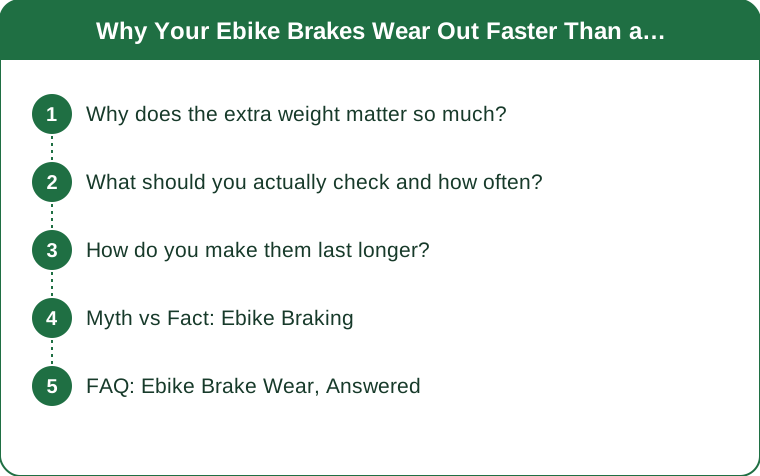
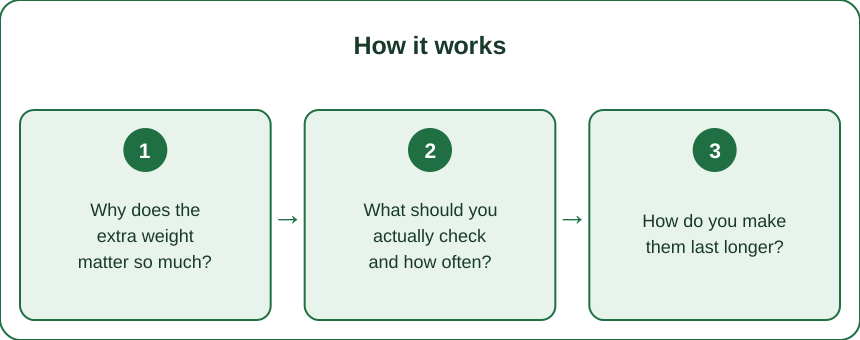
Why does the extra weight matter so much?
Braking converts kinetic energy into heat. Every stop takes the energy of a moving bike and rider and turns it into heat in the pads and rotor. More energy means more heat and more material worn away.
Kinetic energy scales directly with mass. An ebike with motor and battery commonly weighs 8 to 15 kg more than an equivalent non-assisted bike. Add rider and cargo and the total system mass is meaningfully higher on every single stop.
And it scales with the square of speed. This is the bigger factor. Braking from 25 km/h rather than 20 km/h requires roughly 56 percent more energy dissipation, and ebikes maintain higher average speeds as a matter of course.
Assist encourages more stop-start riding. Because getting back up to speed is easy, riders accelerate away from stops more freely and brake more often. On an unassisted bike, people naturally coast to preserve momentum.
Heat itself accelerates wear. Hotter pads wear faster and can glaze, which reduces braking power and encourages harder lever pressure, which produces more heat again.
Which is why the wear is not proportional but multiplied. Higher mass, higher speed, and more frequent braking compound rather than add, and that is the honest explanation for pads that last a season rather than a few years.
What should you actually check and how often?
Check pad thickness every few hundred kilometres. Most disc pads need replacing when the friction material is down to around 1mm, above the metal backing plate. A quick look with a torch every couple of weeks of commuting is enough.
Listen for the change before you see it. A light metallic scraping usually means the material has gone and the backing plate is contacting the rotor, which damages the rotor - a much more expensive component.
Check rotor thickness too. Rotors have a stamped minimum thickness, commonly around 1.5mm. A rotor worn past that should be replaced regardless of how the pads look.
Watch for lever travel increasing. A lever coming closer to the bar over time is the most common early symptom, and it is easy to notice if you pay attention to it once a week.
Keep the rotors clean and oil-free. Contamination causes noise, reduces power, and can ruin a set of pads immediately. Isopropyl alcohol and a clean cloth is the standard approach, and chain lube should never get near a rotor.
And check both wheels. The front does most of the braking work on any bike, so front pads typically wear noticeably faster than rear - checking only one gives you a misleading picture.

How do you make them last longer?
Brake earlier and more gradually. Spreading a stop over a longer distance produces less peak heat than a hard late stop, and lower peak temperatures mean slower wear. It is also safer on a heavy bike.
Use both brakes together. Relying on the rear because it feels safer means the rear does work it is not sized for, wears quickly, and provides less stopping power. Front-biased but two-handed braking is both more effective and easier on the components.
Anticipate rather than react. Looking further ahead is the single biggest factor in how often you brake at all, and braking less is the most effective way to wear pads less.
Use the assist level to manage speed on descents. Reducing assist and letting the bike settle at a manageable speed reduces how much braking is needed at the bottom.
Consider sintered metallic pads for heavy use. They typically last longer and handle heat better than organic pads, at the cost of more noise and slightly less initial bite when cold. For a heavy commuting ebike, the trade is often worth it.
And keep the bike clean in wet weather. Grit is abrasive, and a wet gritty rotor grinds pads away dramatically faster than a clean dry one - which is why autumn and winter wear rates are worse.
Myth vs Fact: Ebike Braking
Myth: Fast pad wear means a fault. Fact: pads are a consumable and ebikes consume them faster. Wear rates several times higher than an equivalent unassisted bike are expected rather than symptomatic.
Myth: Regenerative braking removes the need for pads. Fact: most ebikes have no regeneration at all, and where it exists it typically handles only light deceleration. Mechanical brakes still do essentially all the real stopping.
Myth: Rear braking is safer. Fact: rear-only braking dramatically increases stopping distance on a heavy bike. Progressive use of both, with the front doing most of the work, is both safer and gentler on components.
Myth: Squealing means worn pads. Fact: squealing usually indicates contamination, glazing, or vibration. Worn-out pads more typically produce a grinding sound, which is a more urgent signal.
Myth: All pads are interchangeable. Fact: pad shape is specific to the caliper, and compound choice affects wear, noise, and cold bite. Check the caliper model rather than buying generically.
Myth: You can bed in new pads by riding normally. Fact: a deliberate bedding-in process of repeated moderate stops from moderate speed transfers material evenly and improves both performance and pad life significantly.
FAQ: Ebike Brake Wear, Answered
How often should I replace ebike brake pads?
By inspection rather than by calendar - replace when the friction material is down to around 1mm. On a regularly ridden commuting ebike that can mean every few hundred to a couple of thousand kilometres depending on terrain and weather.
Why do ebike brakes wear so much faster?
Because braking dissipates kinetic energy, which rises with mass and with the square of speed. An ebike is heavier and ridden faster, and assist encourages more frequent stop-start riding.
Are metallic pads better for an ebike?
Sintered metallic pads generally last longer and handle heat better, which suits heavier bikes and regular commuting. They are noisier and have slightly less bite when cold.
What does a grinding noise mean?
Usually that the friction material is gone and the backing plate is contacting the rotor. Stop riding on it - continuing damages the rotor, which costs considerably more than pads.
TL;DR:
- Braking converts kinetic energy to heat, and that energy rises with mass and with the square of speed - both higher on an ebike.
- Assist also encourages more frequent stop-start riding, so the effects compound rather than add.
- Inspect pads every few hundred kilometres, replace at around 1mm of material, and check rotor minimum thickness too.
- Brake earlier and progressively, use both levers with a front bias, and keep rotors clean and oil-free.
- Consider sintered pads for heavy commuting, and treat pads as a consumable rather than as evidence of a fault.
Nothing is wrong with your brakes. They are just doing several times the work they would on a lighter, slower bike.
Keep Reading
This article is for general informational and styling purposes only. Fit, sizing, and product availability may vary.