Resin or Metallic Brake Pads for Wet Autumn E-Bike Riding?
Quick Answer: For wet autumn riding on a heavier e-bike, sintered metallic pads are usually the better choice - they handle water, grit and heat far better and last considerably longer, which matters because an e-bike puts much more energy into the brakes than a regular bike. The trade-offs are more noise, a slightly less sharp initial bite when cold, and faster rotor wear. Resin pads are quieter and bite better cold, but they wear quickly in wet grit and can fade on long descents. If you ride daily through autumn and winter, go metallic and accept the noise.
Brake pads are the least interesting component on a bike and the one that changes the most about how it feels to ride in October.
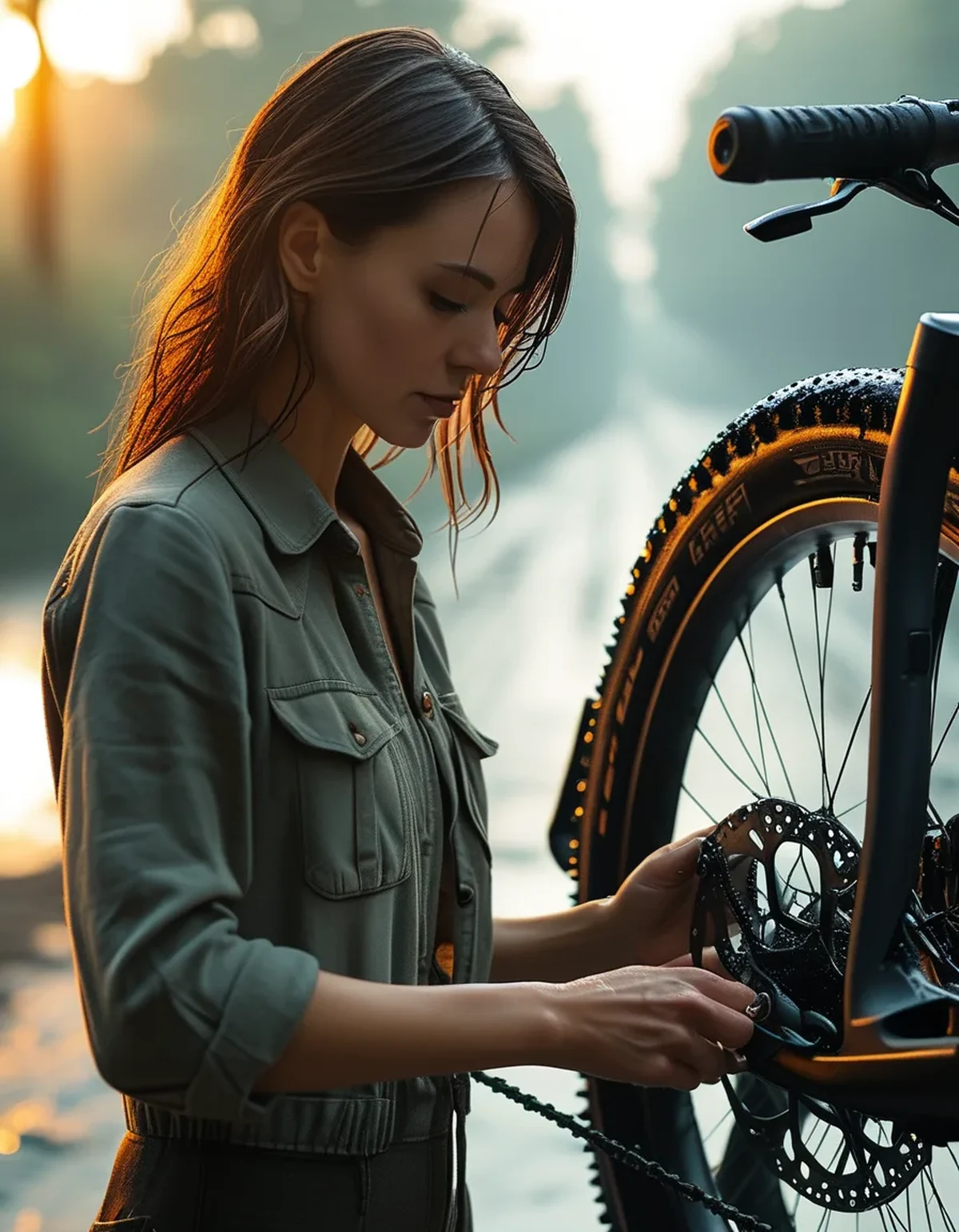
They matter more on an e-bike for a straightforward reason: you are heavier and faster. A loaded e-bike can easily be 25 to 30 kg before you get on it, and it carries speed more consistently. All of that energy has to be turned into heat by two small pads.
Then add wet roads and the grit that comes with them, and pad choice stops being a detail.
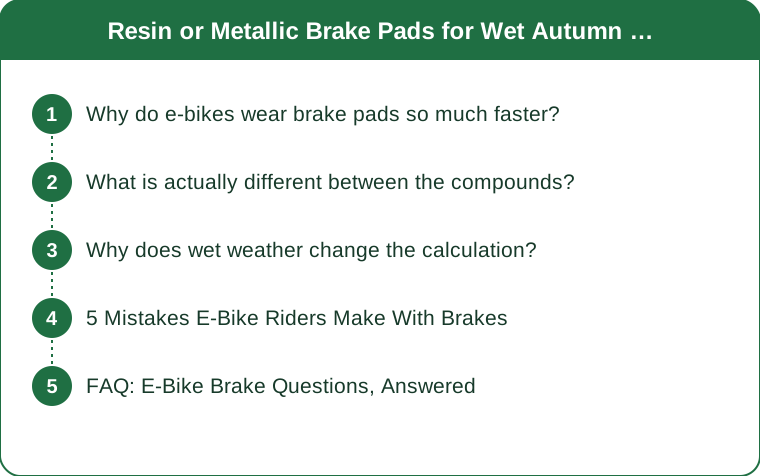
Why do e-bikes wear brake pads so much faster?
Kinetic energy scales with mass and with the square of speed, and e-bikes increase both.
A conventional bike plus rider might be 90 kg. An e-bike plus rider is commonly 105 to 115 kg, and with cargo or a child seat, more. That is a 15 to 25 percent increase in mass alone.
The speed effect is larger. Because energy scales with the square of velocity, maintaining 20 mph rather than 15 is not 33 percent more energy - it is closer to 78 percent more. And the point of assist is that you maintain higher speeds more consistently, including up to junctions and down hills.
On top of that, e-bike riders tend to brake later and harder, because the bike accelerates back to speed easily. There is less incentive to coast down to a junction.
Put together, e-bike pads commonly last a third to half as long as the same pads on a regular bike. That is not a fault; it is arithmetic.
The practical consequences:
- Check pads far more often than you would on a regular bike - monthly during wet season is not excessive
- Heat management matters more, particularly on descents, where pads and rotors get genuinely hot
- The pad compound matters more, because you are operating closer to the limits of what the pad can do
What is actually different between the compounds?
Resin (also called organic) pads are made of composite material bound with resin.
- Better initial bite when cold - they grab quickly from the first pull, which is what makes them feel good on a short commute
- Much quieter - the noise difference is substantial and it is the main reason people prefer them
- Gentler on rotors, so rotors last longer
- Wear faster, dramatically so in wet, gritty conditions
- More prone to fade when they get hot on a long descent
- Can glaze if overheated, which produces a hard shiny surface with poor braking that needs sanding or replacement
Sintered (metallic) pads are made from metal particles fused under heat and pressure.
- Far more durable, often two to three times the life in wet conditions
- Better wet performance - they clear water and grit more effectively
- Much better heat handling, so they resist fade on long descents
- Noisier, particularly when wet, and often noisy for the first minute of any wet ride
- Less bite when cold - they need a little heat to reach full performance
- Wear rotors faster
Semi-metallic pads sit between the two and are a reasonable default if you cannot decide.
And one thing that overrides all of it: check what your brake manufacturer specifies. Some brake systems, and particularly some rotors, are designed for one compound and can be damaged by the other. Resin-only rotors exist and using metallic pads on them will destroy them. Check before buying.
Why does wet weather change the calculation?
Because wet conditions attack pads through two mechanisms at once, and grit is by far the worse of them.
Water reduces friction briefly. The first pull of the brakes on a wet rotor has noticeably less bite while the pads clear the water film. Sintered pads clear it faster.
Grit is the real problem. Wet roads carry a slurry of road dirt, sand and organic material straight onto the rotor and into the pad surface. That slurry acts as a grinding paste. This is why pad wear in a wet autumn month can exceed wear across an entire dry summer - and it is the main argument for metallic pads through the wet season.
Wet leaves make it worse. Decomposing leaf matter is fine, wet, and gets everywhere, and it both contaminates pads and reduces friction. This is very much a late-August-into-autumn issue, and it is starting now.
Contamination is a separate, common failure. Any oil - chain lube overspray, road oil, degreaser - on a pad ruins it. Contaminated pads cannot be reliably cleaned and should be replaced. The symptom is a squeal plus a sharp drop in braking power, and it is far more common in wet weather, when road oil lifts off the surface.
Two practical habits worth having:
Dry your brakes on approach. A light drag on the brakes a few seconds before you actually need them clears the water film so the real stop is at full power. Standard wet-weather riding practice and genuinely effective.
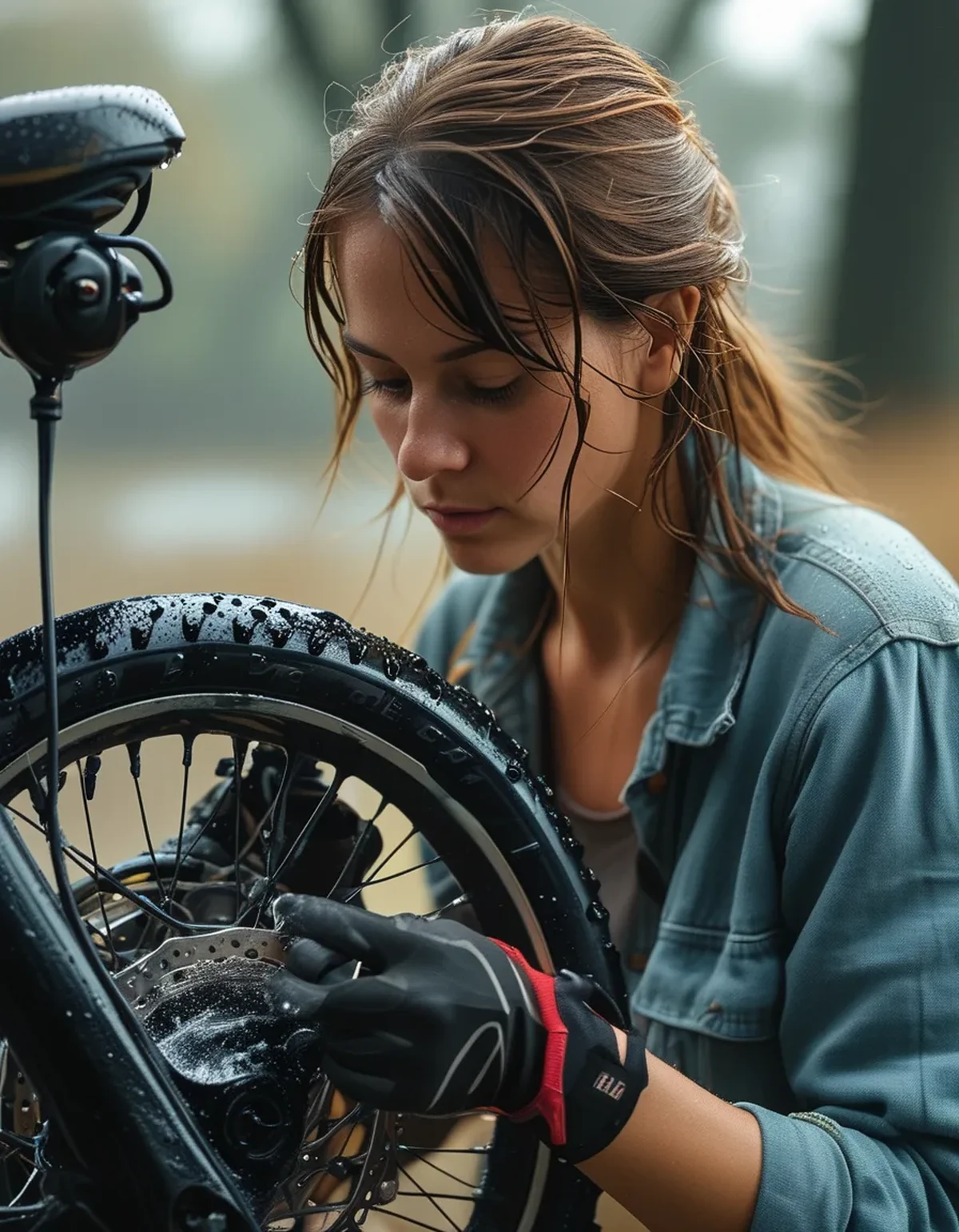
Rinse the rotors after a filthy ride. Plain water, no degreaser near the pads. Removing the grinding paste before it dries on is one of the cheapest things you can do for pad life.
5 Mistakes E-Bike Riders Make With Brakes
1. Checking pads on a regular-bike schedule. E-bike pads wear two to three times faster. Monthly checks in wet season, and know what the minimum thickness looks like - roughly 0.5 mm of pad material above the backing plate on most systems, but check your manufacturer’s figure.
2. Ignoring noise. A new squeal usually means something specific: contamination, glazing, a bent rotor, or pads worn to the backing. Metallic pads are noisy when wet as a matter of course, but a change in the noise is information.
3. Using degreaser near the rotor. It contaminates pads instantly and irreversibly. Isopropyl alcohol on rotors only, and keep everything else away from the braking surface.
4. Not bedding in new pads. New pads need a bedding-in procedure - roughly ten moderate stops from about 15 mph, then a few harder ones, without coming to a complete stop. Skipping it means poor braking for the first week and increased risk of glazing.
5. Riding with worn pads because they still work. They work until they very suddenly do not, and pad material worn to the backing plate destroys the rotor - turning a cheap job into an expensive one. On a heavy bike carrying speed, this is not the component to run to failure.
FAQ: E-Bike Brake Questions, Answered
How often should I actually check my pads?
Monthly through autumn and winter, and every couple of months in dry conditions. An e-bike ridden daily in wet weather can go through a set of resin pads in a matter of weeks, which surprises people coming from regular bikes. It takes thirty seconds with a torch to look at pad thickness through the caliper - make it part of the same routine as checking tyre pressure.
Are metallic pads worth the extra noise?
For wet-season daily riding, generally yes. You are trading noise for meaningfully longer life, better wet performance and better heat handling - all three of which matter more on a heavier, faster bike. If your riding is mostly dry, short, and in quiet residential areas, resin pads are perfectly reasonable and considerably more pleasant to live with.
Can I mix pad types front and rear?
Yes, and some riders do it deliberately - metallic at the front where most of the braking force goes and heat builds, resin at the rear for quieter, gentler modulation. Just make sure both are compatible with your rotors, and do not mix compounds within a single caliper, which gives uneven wear and poor feel.
General maintenance information. If you are unsure about brake condition or compatibility, a bike shop check is cheap - brakes on a heavy, fast bike are not the place to guess.
TL;DR:
- E-bikes wear pads two to three times faster - more mass, more speed, and energy scales with the square of velocity.
- Sintered metallic wins for wet autumn: better wet performance, far longer life, better heat handling. Costs you noise and rotor wear.
- Resin is quieter and bites better cold, but wears fast in wet grit and can fade on descents.
- Check rotor compatibility first - resin-only rotors exist and metallic pads will ruin them.
- Drag the brakes briefly to dry them before you need them, and rinse rotors after filthy rides.
Wet leaves and road grit are starting now. Pads chosen for July riding are the wrong pads for the next four months, and it is a thirty-second check.
Keep Reading
This article is for general informational and styling purposes only. Fit, sizing, and product availability may vary.