How to Actually Get Fitter on an E-Bike
Quick Answer: E-bikes produce a genuine training effect when you keep the assistance low enough that you are still working. Research consistently finds e-bike riding reaches moderate intensity for most riders. The practical levers are: use the lowest assist level that keeps the ride enjoyable, maintain a cadence of around 70-90 rpm rather than grinding in a high gear, and choose routes with terrain rather than avoiding it. The assistance should extend your range, not remove the effort.
The question is always whether an e-bike counts as exercise.
It counts as much as you let it, and the settings decide.
This is general information, not medical advice.

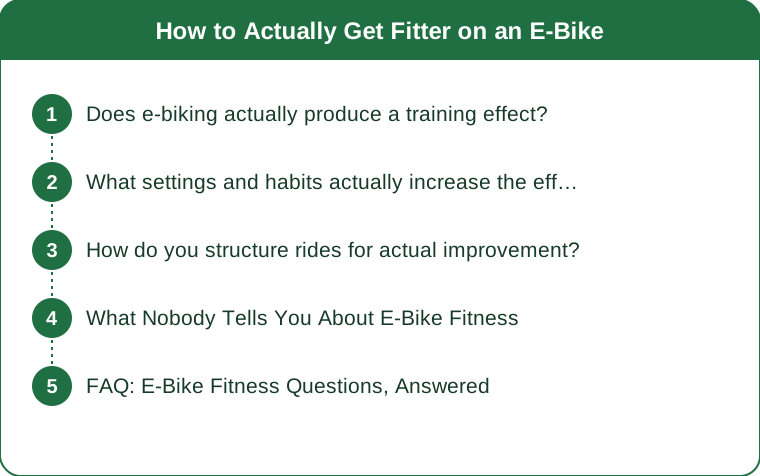
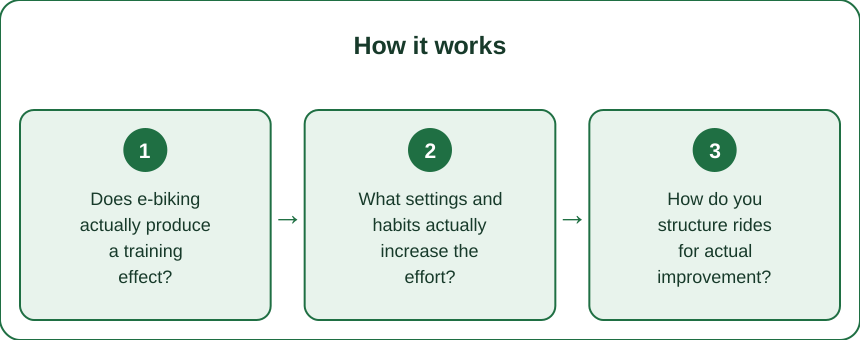
Does e-biking actually produce a training effect?
Yes, and the research on this is reasonably consistent.
Multiple studies comparing e-bike riding to conventional cycling have found that e-bike riders reach moderate-intensity exercise levels, typically in the range that public health guidance identifies as beneficial. The intensity is lower than conventional cycling at the same speed - which is the point of the assistance - but it is well above sedentary and above walking for most riders.
The more interesting finding concerns total volume. Studies of e-bike ownership have consistently found that riders travel further and ride more frequently than they did on conventional bikes. Longer rides, more often, at moderate intensity can produce more total training stimulus than shorter, harder rides done rarely.
This is the argument that matters most. The best exercise is the one you actually do, and an e-bike converts journeys that would have been car journeys into moderate-intensity activity.
Where e-bikes genuinely fall short: if your goal is high-intensity training or peak cardiovascular development, assistance works directly against it. You cannot reach the top end of your effort range while a motor is removing load.
Who benefits most:
- People returning to activity after a break, injury or illness
- Riders in hilly areas where the terrain otherwise makes cycling impractical
- Commuters who would otherwise drive
- Older riders maintaining activity as capacity changes
- Riders with joint issues where load management matters
The framing worth adopting: the e-bike is not a lesser bicycle. It is a device that adjusts the difficulty of the terrain, and you control how much.
What settings and habits actually increase the effort?
Four levers, and the assistance level is only the first.
1. Use the lowest assist level you find tolerable. The obvious one, and worth being deliberate about. Most e-bikes have three to five levels, and most riders default to a middle setting permanently.
A practical approach: start the ride on the lowest level and only increase it when you genuinely need it - a steep section, a headwind, or the last few kilometres home. Riding entirely in the highest assist is where the training effect largely disappears.
2. Maintain cadence rather than grinding. This is the one people get wrong. Cycling in too high a gear at a low cadence feels hard and is less effective aerobically - it loads muscles more than it loads the cardiovascular system.
A cadence of roughly 70-90 rpm is the commonly recommended range for efficiency and aerobic benefit. On an e-bike, keeping cadence up while lowering assistance is the combination that produces effort.
3. Choose terrain rather than avoiding it. The e-bike makes hills possible. Using that to ride hilly routes at a moderate effort produces far more stimulus than using it to flatten a flat route into no effort at all.
4. Ride longer. The e-bike’s real advantage is range. A 25km ride at moderate intensity is a substantial amount of activity, and it is accessible on an e-bike to riders for whom it would not be otherwise.
A useful self-check: are you breathing noticeably harder than at rest? If you can hold a full conversation with no change in breathing for the entire ride, the assistance is too high. You should be able to talk in sentences but notice your breathing - that is the moderate-intensity zone.

How do you structure rides for actual improvement?
Three approaches, depending on what you have available.
Approach 1: progressive assist reduction. The simplest. Ride the same route weekly and reduce the assist level over time. Week one at level three, week four at level two, week eight at level one. The route stays the same and the effort increases - it is progressive overload with a dial.
Approach 2: intervals using the assist level. The assist setting is effectively a resistance control. Ride two minutes at low or no assist, then two minutes at higher assist to recover, repeated. This produces a genuine interval session and is easier to control than terrain-based intervals.
Approach 3: distance progression. Keep the assist level constant and increase distance by roughly 10% per week. Useful for building endurance and for riders returning to activity.
On heart rate: if you have a monitor, it removes the guesswork entirely. Moderate intensity is typically described as around 50-70% of maximum heart rate, and vigorous above that. An e-bike ride at low assist on rolling terrain will frequently sit in the moderate range for the whole duration, which is exactly what public health guidance recommends.
On frequency: the guidance most commonly cited is 150 minutes of moderate activity per week. Three 50-minute e-bike rides meets it. Commuting twice a day meets it comfortably.
One caution about battery management: planning a route that requires high assist to get home means you have to use it. Charge fully, know your range, and plan routes with margin so that the assist level stays a choice rather than a necessity.
What Nobody Tells You About E-Bike Fitness
Five things that change how you use one.
The consistency effect is probably the largest benefit. Research on e-bike ownership repeatedly finds increased riding frequency and distance. Someone riding four times a week at moderate intensity is doing more total work than someone riding once a fortnight at high intensity - and the e-bike is often what makes the four times happen.
Hills stop being a reason not to ride. For many people, terrain is the actual barrier to cycling, not fitness. An e-bike removes the barrier while keeping the ride.
Weight makes the bike itself a factor. E-bikes typically weigh substantially more than conventional bikes - often 20-30kg. This matters for lifting, for carrying up steps, and for the battery-empty scenario, which is a genuinely different ride from a normal bicycle.
You will get less fit going downhill and more fit going up. Obvious once stated, and it changes route planning. A route with sustained climbing at low assist is a far better session than a flat route at any assist level.
The assist level should be a decision, not a setting. Most riders choose a level on day one and never change it. Treating it as something you adjust during a ride - the way you use gears - is the single change that turns transport into training.
FAQ: E-Bike Fitness Questions, Answered
Do e-bikes actually count as exercise?
Yes - studies consistently find e-bike riding reaches moderate intensity for most riders, which is the level public health guidance recommends. It is lower intensity than conventional cycling at the same speed, and well above sedentary.
What assist level should I use?
The lowest that keeps the ride enjoyable enough that you do it. Start each ride on the lowest and increase only when you need it - hills, headwinds, or the final stretch. Permanently riding in the highest level is where the training effect goes.
Will I get fitter over time?
Yes, if you progressively reduce assistance, increase distance, or choose harder terrain. Without progression of some kind, you will maintain rather than improve - the same as any activity done at a constant level.
Is an e-bike good for weight management?
It contributes as moderate-intensity activity, and the volume matters more than the intensity here. Riders who replace car journeys with e-bike journeys typically add substantial weekly activity. Diet remains the larger factor.
Can I use an e-bike for interval training?
Yes, and the assist level works well as a resistance control - alternate low-assist work periods with higher-assist recovery. It is easier to control than terrain-based intervals.
What if my fitness improves and the e-bike becomes too easy?
Reduce the assist, ride further, or ride hillier routes. All three are available before you need different equipment, and most riders never exhaust them.
TL;DR:
- E-bike riding reaches moderate intensity for most riders, which is the level public health guidance targets
- The biggest benefit is volume - owners ride further and more often, which often outweighs the lower intensity
- Start each ride on the lowest assist and increase only when needed; treat it like a gear, not a setting
- Keep cadence around 70-90 rpm rather than grinding in a high gear
- Choose hilly routes rather than avoiding them - the assist makes terrain accessible, not irrelevant
- Progress by reducing assist on the same route, adding distance, or using assist levels as intervals
The motor decides how hard the hill is. You decide how much motor.
Keep Reading
This article is for general informational and styling purposes only. Fit, sizing, and product availability may vary.