Riding an E-bike Loaded: What Changes When You Add Cargo or a Passenger
Quick Answer: Adding load barely affects an e-bike’s ability to accelerate because the motor compensates, which is precisely what makes it deceptive. Braking distance increases substantially, steering becomes slower and heavier, and low-speed balance gets much harder - especially with a rear-mounted child seat, which raises the centre of mass. Check the manufacturer’s total weight limit, load low and centred, brake earlier, and practise starting and stopping somewhere quiet before carrying anyone.
The first ride with a full rear rack feels fine. The motor takes the strain and you barely notice the weight until the moment you need to stop, or turn sharply, or put a foot down at a junction - and all three of those arrive without warning.
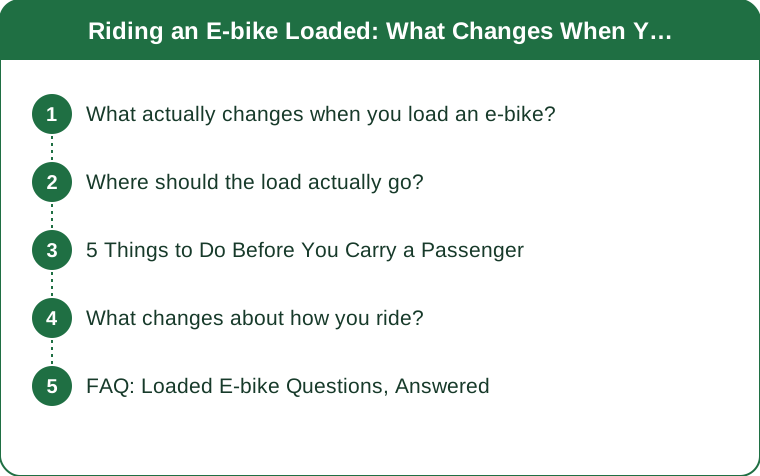
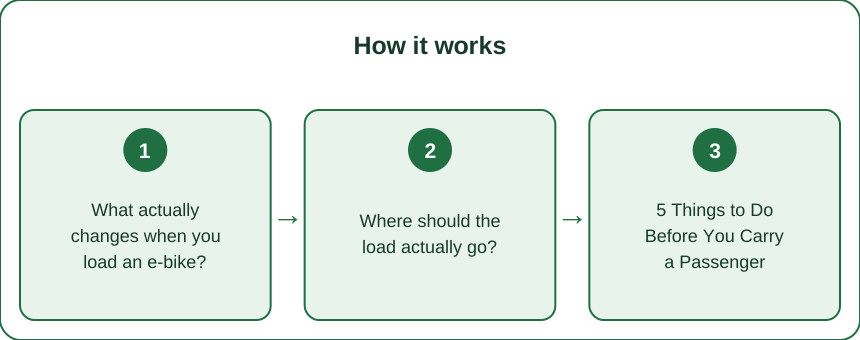
What actually changes when you load an e-bike?
Four things, and the motor hides the first one so effectively that people miss the other three.
Acceleration barely changes. The motor provides the extra torque, so a loaded e-bike pulls away much like an unloaded one. This is genuinely useful and it is also why riders do not recalibrate - the feedback that normally tells you the bike is heavy has been removed.
Braking distance increases substantially. Stopping distance scales with mass. Adding 25 kilograms of child and seat to a 25-kilogram bike and a 65-kilogram rider increases total mass by roughly 20 percent, and the brakes have to dissipate proportionally more energy. E-bikes are already heavier than conventional bikes, which is why they are typically fitted with hydraulic disc brakes - but the physics still applies.
Steering becomes slower and heavier. More mass means more inertia to overcome when changing direction. Quick avoidance manoeuvres take longer and require more input, which matters most in exactly the urban environments where cargo bikes are used.
Low-speed balance becomes considerably harder. This is the one that causes most incidents. Below walking pace - at junctions, in queues, when starting off - a raised centre of mass makes the bike want to fall over, and a rear child seat raises it significantly. A child moving unexpectedly at a stop is the classic scenario, and it happens at zero miles an hour.
And the effect depends heavily on where the load sits, which is the next question.
Where should the load actually go?
Low and centred, in that order of priority.
Front cargo box or low-mounted front rack - best. A low front load keeps the centre of mass low and puts weight over the steering axis, which some riders find changes handling feel but keeps stability high. This is why longtail and box-style cargo bikes are designed the way they are rather than as ordinary bikes with a rack bolted on.
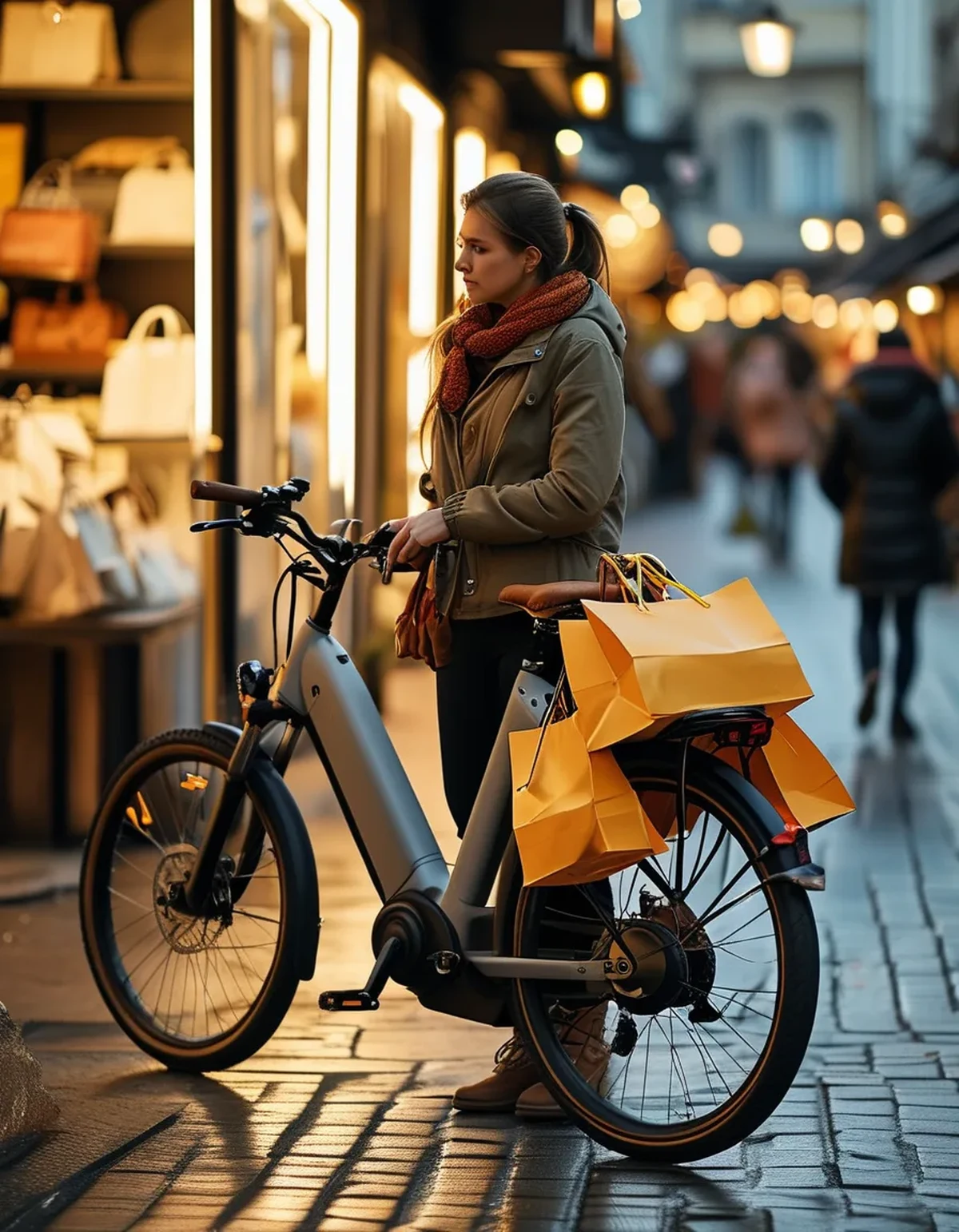
Panniers on a rear rack - very good. Weight sits low, on both sides, close to the axle. This is the most stable way to carry shopping on a conventional-shaped bike, and it is substantially better than the same weight in a bag on top of the rack.
On top of a rear rack - acceptable for light loads. Higher centre of mass, more effect on handling. Fine for a jacket and a small bag, worse for 15 kilograms of shopping.
Rear child seat - the highest centre of mass and the most movement. Necessary and widely used, but the load is high, it is behind the rear axle in many designs, and it moves independently. This combination requires the most adjustment from the rider.
Backpack on your own back - worst. The weight is at the highest possible point and it moves with you rather than with the bike, which makes balance and steering worse than the same weight on the bike. Riders routinely do this and it is the least stable option available.
And balance side to side. Twelve kilograms in one pannier and nothing in the other produces a persistent pull, and it is noticeably worse at low speed. Split loads evenly even if it means repacking in the car park.

5 Things to Do Before You Carry a Passenger
1. Check the actual weight limit, and check both numbers. Manufacturers specify a maximum total weight - bike, rider, and cargo combined - and a separate rack limit. Both are in the manual and both are commonly exceeded without anyone realising. Frame, wheels, and brakes are engineered around those numbers, and exceeding them is a genuine safety and warranty issue.
2. Verify the bike is rated for a passenger at all. Not all e-bikes are. Many standard e-bikes are explicitly not approved for child seats or passengers, and fitting one to an unrated frame or a rack not designed for it is a real risk rather than a technicality. Purpose-built cargo and longtail e-bikes are rated for it; most standard commuter e-bikes are not.
3. Practise loaded, without the passenger, somewhere empty. Load the seat with a sandbag or equivalent weight and spend fifteen minutes in a car park practising starting, stopping, slow turns, and putting a foot down. The handling difference is large and you want to meet it without a child on board.
4. Check your brakes properly. Pad wear, lever feel, and whether the bike stops in a straight line. Loaded riding accelerates pad wear noticeably, so the inspection interval should be shorter than you are used to.
5. Set assist level lower, not higher. The instinct is to raise assist because the bike is heavier. Lower assist gives smoother, more predictable power delivery at the low speeds where a loaded bike is least stable. A sudden surge of torque pulling away from a junction with a child on the back is exactly the wrong thing at the wrong moment.
What changes about how you ride?
Six adjustments, all of which become automatic within a couple of weeks.
Brake earlier and more gently. Double your usual following distance and start braking sooner. Progressive braking is both more effective and less likely to unsettle a load or a passenger than a late hard stop.
Use both brakes together. Loaded, the weight distribution shifts rearward, so the rear brake contributes more than it does on an unloaded bike. Front-only braking is less effective and less stable in this configuration.
Take corners slower and wider. More mass means more effort to change direction and more tendency to run wide. Slow before the corner rather than during it.
Plan the stop before you arrive. Pick where you will put your foot down. On a loaded bike, being caught in the wrong gear or the wrong position at a stop is how low-speed falls happen.
Watch the low-speed moments. Junctions, queues, driveways, and the moment of loading and unloading. Most incidents with child seats happen at or near zero speed, often while the bike is stationary and being loaded - which is why a proper double-legged kickstand is genuinely important on a bike used for passengers.
And check the load before every ride. Straps loosen, bags shift, and a child seat’s harness needs checking each time rather than each week. It takes twenty seconds.
One more thing: range drops with load, sometimes considerably. Extra mass means more work for the motor on every hill and every acceleration. If you are running close to your battery’s range unloaded, expect a shorter ride loaded, particularly on a hilly route.
FAQ: Loaded E-bike Questions, Answered
Can you carry a passenger on any e-bike?
No. Many standard e-bikes are not rated for passengers or child seats, and the manufacturer’s manual will state whether it is approved and what the total weight limit is. Purpose-built cargo and longtail e-bikes are designed for it; adapting an unrated bike is a genuine risk.
How much weight can an e-bike carry?
It varies by model and is specified as a maximum total weight - bike, rider, and cargo combined - with a separate rack limit. Check both in the manual rather than assuming. Cargo e-bikes are commonly rated far higher than standard commuter models.
Does carrying cargo reduce e-bike range?
Yes, sometimes noticeably. Additional mass increases the work required on every hill and every acceleration. On a hilly route with a heavy load, expect a meaningful reduction and plan accordingly.
Where is the safest place to carry weight on an e-bike?
Low and centred - a low front cargo area or panniers on a rear rack, balanced side to side. Weight on top of a rear rack raises the centre of mass, and a backpack on your own back is the least stable option of all.
TL;DR:
- The motor hides the added weight during acceleration, which is exactly why riders do not adjust.
- Braking distance, steering effort, and low-speed balance all get meaningfully worse.
- Load low and centred; panniers beat rack-top, and both beat a backpack.
- Check both weight limits in the manual, and confirm the bike is rated for a passenger at all.
- Practise loaded in an empty car park before anyone rides on the back.
The bike feels the same until the moment it does not, and that moment is usually a junction at walking pace. Meeting it deliberately in a car park is a much better introduction.
Keep Reading
This article is for general informational and styling purposes only. Fit, sizing, and product availability may vary.