Riding an E-Bike on Wet Leaves: Braking, Cornering, and the Extra Weight
Quick Answer: Wet leaves can reduce available grip dramatically - on painted lines and metal covers, close to ice. An e-bike compounds this because it typically weighs 20-30 lbs more than an equivalent bike, which lengthens braking distance, and because torque at the rear wheel can break traction on a slick surface. Ride it by braking earlier and mostly with the front, cornering upright and slow, and dropping to a lower assist level where the surface is uncertain.
The leaf hazard is easy to underestimate because it looks like scenery rather than a road condition.
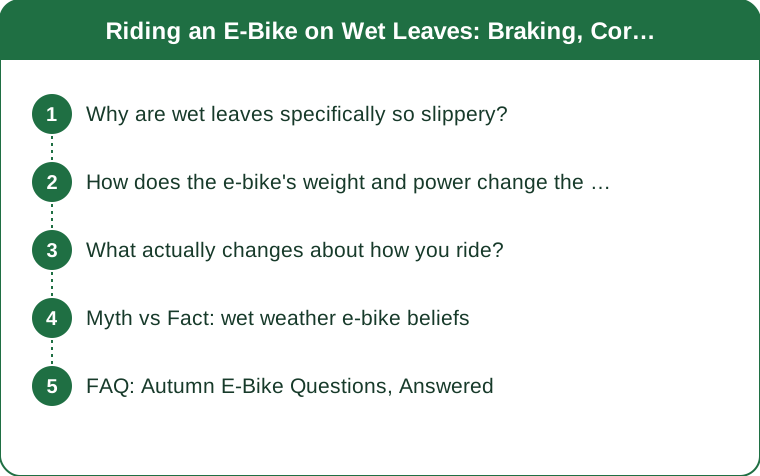
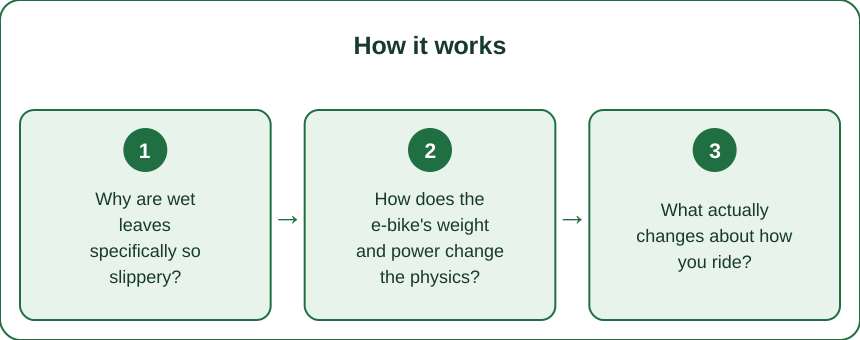
Why are wet leaves specifically so slippery?
A dry leaf on pavement is a minor nuisance. A wet one is a different material entirely.
When leaves get wet and start to break down, they release tannins and pectins that form a thin, slick organic film on the road surface. That film has a very low coefficient of friction - on painted road markings and metal utility covers, where the underlying surface is already slick when wet, the combination approaches ice.
Layers make it worse. A single wet leaf can slide out from under a tire; a compressed mat of them acts like a loose surface where the top layer moves independently of the bottom. Neither your tire nor your steering input reaches solid ground.
Where it is worst:
- Painted lines and crosswalks under leaves - the two lowest-grip surfaces stacked.
- Metal drain covers and rail crossings.
- Shaded corners where leaves stay damp for weeks and where you happen to be leaning.
- The gutter line, where leaves accumulate and where cyclists often ride.
- Bridges and boardwalks, where the deck stays wet longer and gets frosty first.
And an e-bike specific factor: wider, heavier tires often used on e-bikes give more contact area, which helps - but the extra mass they are supporting more than offsets it in braking. Contact patch helps grip; mass hurts stopping distance.
How does the e-bike’s weight and power change the physics?
Braking distance. Kinetic energy scales with mass, so a heavier bike carries more energy at the same speed and needs more distance or more braking force to stop. A typical e-bike plus rider is meaningfully heavier than an analogue bike plus the same rider, and on a low-grip surface where you cannot apply more force without losing traction, the only remaining lever is more distance.
Torque and traction loss. Mid-drive and hub motors both deliver power smoothly, but the torque available from a standing start is substantial. On wet leaves at a junction, applying full assist can spin the rear wheel - which on a bike does not cause a dramatic slide, but it does cause a moment of unpredictable steering and a lot of lost momentum. Start in a lower assist level.
Momentum in corners. More mass means more energy to change direction, and cornering forces are the ones that break traction first. This is where wet leaves actually put people down - a lean angle that would be trivially safe in summer.
Regenerative braking, on bikes that have it, applies braking force to the rear wheel. On a low-grip surface, rear-wheel braking is the most likely to lock and slide. Reduce or disable it in these conditions if your system allows.
The compensating factor: e-bikes generally have better brakes - hydraulic discs are common - which helps enormously in the wet, where rim brakes lose a significant fraction of their power. On balance, a well-maintained e-bike stops well; it just needs the input earlier.
What actually changes about how you ride?
Brake earlier and more gently. Start braking roughly twice as far out as you would in dry conditions, and squeeze progressively rather than grabbing. Progressive input lets you feel the moment grip starts to go, which a sudden grab does not.
Use mostly the front brake, carefully. Counter-intuitively, the front brake provides most of your stopping power even in the wet, because weight transfers forward under braking. The rule is to apply it smoothly and early, never suddenly. A locked front wheel is the one that puts you down, and it locks when you grab, not when you squeeze.
Do all your braking upright and in a straight line. Braking while leaned into a corner is the classic way to lose the front on a slick surface. Slow down before the corner, then coast or apply light power through it.
Corner upright and slow. Reduce lean angle by slowing more before entry. If you must corner on leaves, keep the bike as vertical as possible and steer more with the bars than the lean.
Sit down and stay smooth. Standing shifts weight forward and reduces rear grip. Sitting keeps weight over the rear wheel and gives you more traction where the power is.
Drop the assist level. In genuinely slippery conditions, one or two levels lower gives you a more forgiving throttle response and reduces the chance of breaking traction.
And avoid the gutter. Ride slightly further out in the lane where the surface is swept clearer by car traffic. This is safer despite feeling more exposed.
Myth vs Fact: wet weather e-bike beliefs
Myth: Wider tires mean leaves are not a problem. Fact: wider tires help with loose surfaces and give more contact area, but on a film-covered surface the limiting factor is the film, not the contact patch. Tire tread pattern and compound matter more than width, and even then, a slick organic film defeats most of it.
Myth: Disc brakes make wet conditions safe. Fact: disc brakes make wet braking power far more reliable than rim brakes - that is real and important. What they cannot change is available tire grip. More braking power on a surface with no grip just locks the wheel sooner.
Myth: Lower tire pressure gives more grip on leaves. Fact: modestly lower pressure does increase contact area and can help on loose surfaces. Going too low risks pinch flats and vague handling, and it does little against a slick film. Drop 5-10 psi from your dry-weather pressure, not more.
Myth: E-bikes are more dangerous in the wet than regular bikes. Fact: they are heavier, which lengthens braking, and they often have better brakes and more stable geometry, which helps. The genuine additional risk is speed - e-bikes make it easy to travel faster than conditions warrant without feeling the effort that would normally signal it.
Myth: You should turn the motor off entirely on slippery roads. Fact: a lower assist level is the useful adjustment. Turning it off entirely on a heavy bike makes it harder to maintain a steady, controlled speed, and steady speed is what keeps you upright.
FAQ: Autumn E-Bike Questions, Answered
Is my e-bike battery affected by cold as well?
Yes, significantly - lithium batteries lose usable capacity in the cold, and a range drop of 20-30% below freezing is common. Store the battery indoors and, where possible, fit it just before riding rather than leaving the bike outside overnight.
Do I need different tires for autumn?
A tire with a defined tread pattern and a softer wet-grip compound genuinely helps on wet pavement and loose debris, though nothing performs well on a leaf film. If you commute year-round, a set of all-weather tires is a reasonable investment.
How much does braking distance actually increase?
Enough that the practical answer is to double your following distance and start braking twice as early. Precise numbers vary too much by surface, tire, and speed to be useful, and the safe assumption is always the pessimistic one.
Are wet leaves worse than ice?
On painted lines and metal covers, comparably bad. The critical difference is that ice is visible and you slow down for it, while leaves look like decoration. That is why leaves cause more autumn falls than the first frost does.
TL;DR:
- Wet leaves release a slick organic film; on paint and metal covers it approaches ice.
- The e-bike’s extra 20-30 lbs lengthens braking - start braking twice as early and squeeze progressively.
- Corner upright and slow, do all braking in a straight line, stay seated, and drop an assist level.
- Ride out of the gutter line where car traffic has swept the surface clearer.
None of this makes autumn riding unpleasant - it just moves your inputs earlier. The riders who go down in October are almost always the ones riding September’s lines.
Keep Reading
This article is for general informational and styling purposes only. Fit, sizing, and product availability may vary.