The Right E-Bike Assist Level for Hill Climbing Without Losing the Workout
Quick Answer: A moderate assist level (roughly the middle setting on most e-bikes) on hills typically keeps cadence and heart rate in a real workout zone while still making steep climbs manageable, whereas jumping straight to the highest assist setting removes most of the muscular effort that makes hill climbing valuable exercise in the first place.
The goal on a hill isn’t necessarily ‘make it as easy as possible’ — it’s finding the assist level where the climb is challenging but sustainable, similar to choosing gears on a traditional bike.

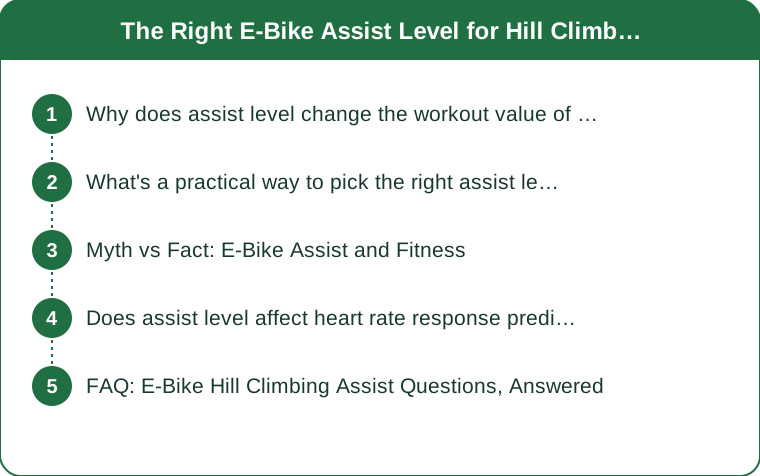
Why does assist level change the workout value of a climb so much?
E-bike motors add power proportional to your pedaling input (in pedal-assist systems), so a higher assist level means the motor contributes more of the total force needed to climb, directly reducing how much your own muscles have to work — this is a fairly direct trade-off between climb difficulty and workout intensity.
What’s a practical way to pick the right assist level for a specific hill?
Starting a climb on a moderate assist setting and adjusting based on whether cadence stays reasonably steady (rather than dropping dramatically or spiking too high) works better than picking one fixed assist level for every hill, since grade and length vary considerably between climbs.

Myth vs Fact: E-Bike Assist and Fitness
Myth: using any assist means you’re not really exercising. Fact: pedal-assist e-bikes still require real muscular effort and cardiovascular engagement at low-to-moderate assist levels — research comparing e-bike and traditional cycling has found meaningful fitness benefits from regular e-bike riding, just generally less than the same ride on a traditional bike.
Myth: higher assist means a shorter, less valuable ride. Fact: higher assist can let you cover more distance or tackle routes with more elevation than you’d otherwise manage, which has its own value for building riding frequency and consistency, even if intensity per mile is lower.
Does assist level affect heart rate response predictably?
Generally yes — dropping assist level on the same hill reliably increases heart rate and perceived effort, making assist level a genuinely useful, adjustable intensity dial similar to choosing a harder gear on a traditional bike, rather than an all-or-nothing choice between ‘workout’ and ‘no workout.’
FAQ: E-Bike Hill Climbing Assist Questions, Answered
Should I turn assist off completely for the best workout on hills?
Not necessarily — on very steep climbs, zero assist can force such a low cadence that form and joint mechanics suffer, so a low (not zero) assist level often gives a better balance of real effort and sustainable technique.
Does a heavier e-bike change how assist level affects effort on hills?
Yes — e-bikes are generally heavier than traditional bikes, so even at a given assist level, climbing an e-bike involves managing more total bike weight, which is a real factor in the overall effort beyond just the assist percentage.
How do I know if I’m using too much assist for my fitness goals?
If a hill that should feel like meaningful effort instead feels nearly effortless, dropping assist by one level and reassessing is a reasonable practical check.
TL;DR:
- Assist level and hill workout intensity trade off fairly directly — more assist means less muscular effort
- Moderate assist on hills typically keeps effort in a real, sustainable workout zone
- E-bike riding still provides meaningful fitness benefit at low-to-moderate assist, just generally less than a traditional bike
- Assist level functions as an adjustable intensity dial, not an all-or-nothing workout switch
Picking assist level deliberately, the way you’d choose a gear, keeps hill climbing both manageable and worthwhile as exercise.
Keep Reading
This article is for general informational and styling purposes only. Fit, sizing, and product availability may vary.