What Late Summer Heat Actually Does to Your E-Bike Battery
Quick Answer: Cold temporarily reduces range and it comes back when things warm up. Heat does the opposite — range often stays fine while the battery permanently ages faster. Lithium-ion cells degrade meaningfully quicker above roughly 86°F, and the damage does not reverse. Store and charge the battery indoors, never leave it in a car or in direct sun, and avoid charging it while it is still hot from a ride.
Your range has not dropped this summer, so the battery must be fine.
That is exactly the problem with heat damage: it is invisible while it is happening, and you find out next spring.
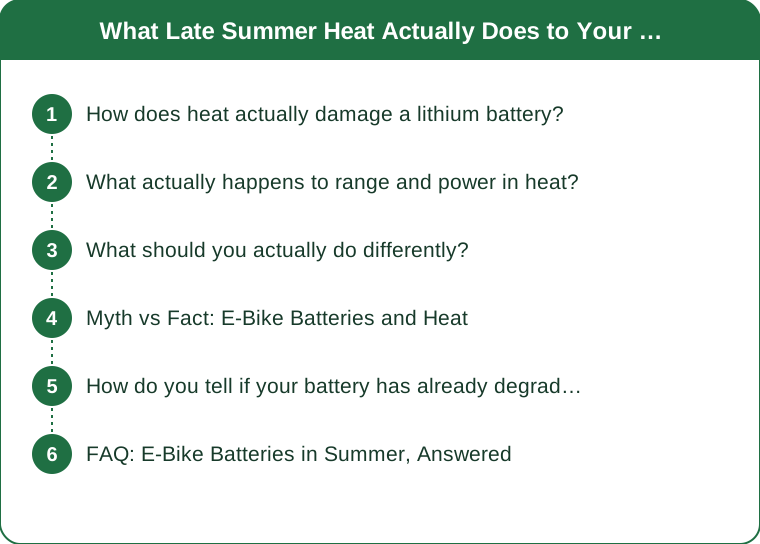
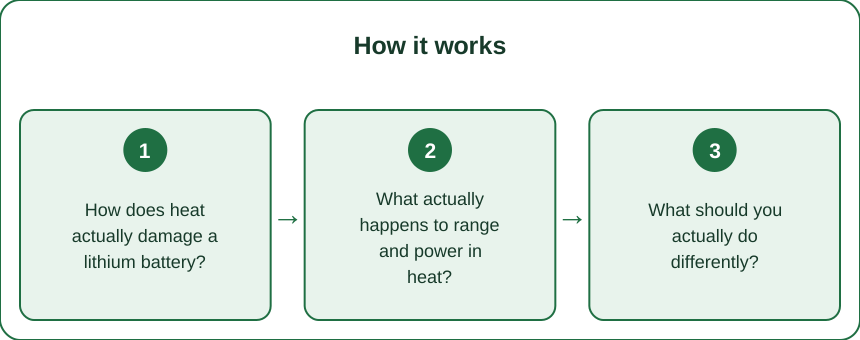
How does heat actually damage a lithium battery?
Cold and heat harm batteries through completely different mechanisms, and that difference is why heat is more insidious.
Cold slows the chemistry. Ion movement inside the cell becomes sluggish, internal resistance rises, and the battery cannot deliver as much power or capacity. This is temporary. Warm the battery back up and the capacity is there again. A cold-weather range drop of 20 to 30 percent is normal and fully recoverable.
Heat accelerates the chemistry, including the reactions you do not want. Elevated temperature speeds up the parasitic side reactions that permanently consume lithium and grow resistive layers on the electrodes. This is not recoverable. Every hour spent hot costs you a small, permanent fraction of the battery’s total life.
The rule of thumb from battery chemistry is that reaction rates roughly double for every 10°C — about 18°F — rise in temperature. A battery stored at 104°F degrades dramatically faster than the same battery at 68°F, and the difference over a summer is substantial.
Two things make it worse:
- State of charge multiplies the effect. A battery held at 100 percent charge in heat degrades much faster than one held at 50 percent in the same heat. Hot and full is the worst combination there is.
- The damage is cumulative and silent. You will not notice it this month. You notice it next spring when the range is meaningfully shorter and does not come back when the weather improves.
That is the crux: cold range loss is a temporary inconvenience; heat range loss is a permanent bill that arrives later.
What actually happens to range and power in heat?
Ride performance in heat is usually fine or slightly better, which is why the damage goes unnoticed.
Range in moderate heat is often unchanged or marginally improved, because the cell chemistry is operating efficiently. A battery performs closest to its rated capacity in the 60 to 80°F range and does not fall off sharply until it gets genuinely hot.
What does change:
- Motor thermal management may reduce output. Many mid-drive and hub motors have thermal protection that cuts power when internal temperature rises. On a long sustained climb in 95°F heat, you may notice assist tapering off. That is protection working correctly, not a fault.
- The battery management system may limit charging or discharging if cell temperature exceeds its safe window. Some systems refuse to charge a hot battery at all, which is a feature.
- Range drops when the battery gets very hot, above roughly 110°F cell temperature, but this is uncommon during riding since airflow cools the pack. It is far more common when parked in the sun.
Where the heat actually accumulates is at rest, not while riding. A bike parked in direct sun on a 90°F day can have battery surface temperatures far above ambient — dark plastic casing in full sun behaves like any other dark object. The two hours your bike spends locked outside a store is doing more damage than the hour you spent riding it.
That reframe is the most useful thing on this page: manage parking and storage, not riding.
What should you actually do differently?
Six practices, roughly in order of impact.
1. Never leave the battery in a parked car. Car interiors reach far above ambient temperature in summer sun — well beyond any safe storage range for lithium cells, within a short period. This is the single most damaging common habit, and it is completely avoidable.
2. Park in shade, and take the battery with you when you can. Most e-bike batteries are removable specifically so they can come inside. If you are stopping for more than a few minutes on a hot sunny day, bring it with you or park where the sun is not on the frame.
3. Do not charge a hot battery. After a hot ride, let the pack cool to roughly room temperature before plugging in — typically 30 to 60 minutes. Charging generates its own heat, and adding that to an already-hot pack is the worst thermal condition you can create. Many BMS units will delay charging for exactly this reason.
4. Store at partial charge in summer. For storage beyond a few days, 50 to 60 percent is the target, not full. Storing a battery at 100 percent in a hot garage is the fastest way to lose capacity. Charge to full shortly before a long ride instead.
5. Store indoors, in the coolest reasonable place. A house or apartment, not a garage or shed, which can run far hotter than outdoor air. Not a basement that gets damp, and not near a heat source.
6. Use a lower assist level on sustained climbs in heat. This reduces motor and battery heat generation at the point where thermal stress is highest, and it also builds fitness — which is why most people bought an e-bike in the first place.
Myth vs Fact: E-Bike Batteries and Heat
Myth: If my range is normal, my battery is fine. Fact: Heat degradation is silent while it happens. Range in heat is often normal or good; the loss shows up months later as permanently reduced capacity.
Myth: Heat and cold are equally bad for batteries. Fact: Cold reduces performance temporarily and reverses completely. Heat causes permanent capacity loss. Cold is an inconvenience; heat is damage.
Myth: I should always keep the battery fully charged so it is ready. Fact: High state of charge accelerates degradation, and it does so much faster in heat. For daily use it barely matters, but for storage of more than a few days — especially in summer — 50 to 60 percent is meaningfully better.
Myth: Riding hard in heat is what damages the battery. Fact: Airflow during riding cools the pack effectively. The damage happens at rest — parked in the sun, in a car, or charging while hot.
Myth: Fast charging is the main culprit. Fact: Fast charging does generate more heat and contributes, but for most riders parking and storage habits dominate. Fix those first.
Myth: A battery in a garage is stored indoors. Fact: An uninsulated garage in summer can run considerably hotter than outdoor air and stays hot long after sunset. It is one of the worst common storage locations, and it is where most people keep the bike.
Myth: You cannot ride an e-bike in very hot weather. Fact: You can, and the bike will be fine. Adjust for your own heat safety, park in shade, and let the battery cool before charging.
How do you tell if your battery has already degraded?
Some capacity loss is normal and expected. The question is whether it is happening faster than it should.
Normal degradation: most e-bike batteries retain roughly 70 to 80 percent of original capacity after several hundred full charge cycles, which for many riders is a few years of regular use. A gradual, modest decline is expected and is not a defect.
Signs of accelerated degradation:
- Range dropped noticeably and did not recover when the weather cooled — the key distinction from a temporary cold-weather loss
- The battery charges to full much faster than it used to, which usually means it is holding less
- Voltage drops sharply under load, showing as assist cutting out on climbs at charge levels that used to be fine
- The last 20 percent of indicated charge disappears very quickly
- The pack gets unusually warm during normal charging
How to check properly: ride a known route on a consistent assist level and compare against your own records from a year ago, same season and similar conditions. That comparison is far more reliable than the range estimate on the display, which is calculated from recent riding and adjusts constantly.
Safety signs that need immediate attention, not diagnosis: any swelling or bulging of the pack, a burning or chemical smell, visible damage to the casing, or a battery that becomes hot to the touch during normal charging. Stop using it, disconnect it, move it away from anything flammable, and contact the manufacturer or a qualified shop. Do not attempt to open or repair a lithium battery pack. This is general information, not a substitute for your manufacturer’s guidance.
Replacement is a normal part of e-bike ownership, and good habits mainly determine whether it happens in year three or year six.
FAQ: E-Bike Batteries in Summer, Answered
What temperature is actually too hot for the battery?
As a general guide, keep the pack below about 86°F when possible for storage, and avoid anything above roughly 113°F entirely. Check your manufacturer’s stated range — it is in the manual and it varies between packs.
Can I ride in 95°F weather?
Yes. Riding provides airflow that keeps the pack cool. Plan for your own heat safety, park in shade, and let the battery cool before charging.
How long should I wait before charging after a hot ride?
30 to 60 minutes at room temperature is a reasonable rule. If the pack still feels warm to the touch, wait longer.
Should I store the battery at 100 percent over winter or summer?
No. For storage of more than a few days, 50 to 60 percent is the target, and check it every couple of months to top it back up if it has drifted low.
Is the garage a bad place to keep my e-bike?
For the bike, usually fine. For the battery in summer, often the worst option in the house — uninsulated garages get very hot and stay hot. Bring the battery inside; it takes ten seconds.
TL;DR: Cold costs you range temporarily; heat costs you battery life permanently.
- Heat accelerates the side reactions that permanently consume capacity — roughly doubling the rate for every 18°F rise.
- Range in heat usually looks fine, which is why the damage goes unnoticed until the following spring.
- The damage happens at rest, not while riding. Parking in sun and leaving the battery in a car do the most harm.
- Never charge a hot battery — wait 30 to 60 minutes after a hot ride.
- Store at 50 to 60 percent, indoors. Hot and full is the worst combination for a lithium cell.
- An uninsulated garage is not indoor storage in summer. Bring the battery inside.
- Swelling, chemical smell, or heat during charging means stop using it and contact a professional.
Take the battery inside tonight. It is ten seconds and it is the highest-value habit on this list.
Keep Reading
This article is for general informational and styling purposes only. Fit, sizing, and product availability may vary.