Does an E-Bike Actually Count as a Real Workout, or Is a Regular Bike Meaningfully Better?
Quick Answer: An e-bike still provides real exercise — pedaling still requires physical effort even with motor assist — but the intensity is meaningfully lower than a regular bike at the same speed and distance, especially at higher assist levels, so an e-bike is a genuine but lower-intensity workout compared to a regular bike, not a non-workout, with the actual fitness benefit depending heavily on assist level and how much effort the rider chooses to contribute.
The ‘cheating’ framing misses that an e-bike is a dial, not a switch — fitness benefit scales down with more assist rather than disappearing entirely.

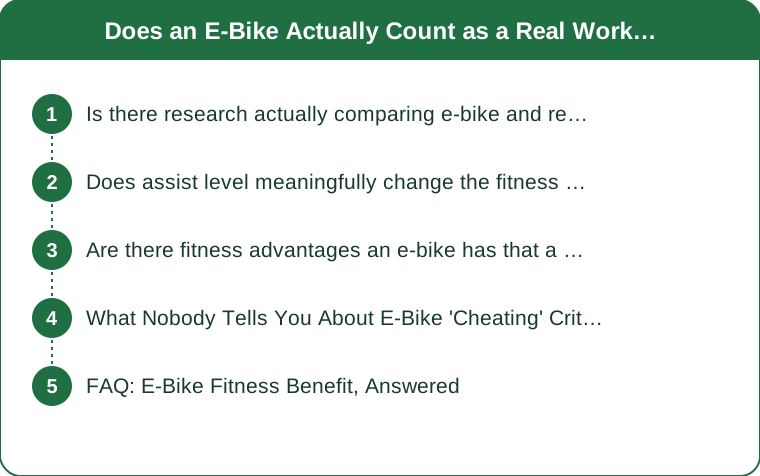
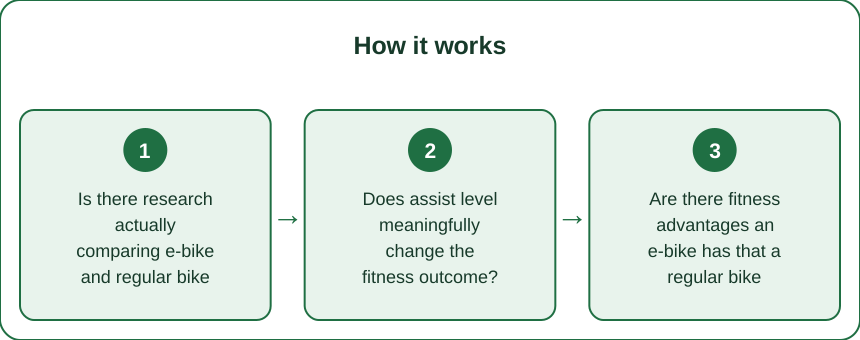
Is there research actually comparing e-bike and regular bike exercise intensity?
Yes — studies measuring heart rate and oxygen consumption during e-bike versus regular bike riding at similar speeds consistently show e-bike riders working at a real but lower physiological intensity, particularly at higher assist levels, rather than showing no measurable effort at all.
Does assist level meaningfully change the fitness outcome?
Significantly — a low assist level requires close to regular-bike effort with the motor mainly helping on hills, while a high assist level can reduce rider effort dramatically, meaning the fitness benefit exists on a real spectrum depending entirely on how the rider chooses to use the available assist.

Are there fitness advantages an e-bike has that a regular bike doesn’t?
Yes — e-bikes make longer rides, hillier routes, and more frequent riding more accessible for people who might otherwise be deterred by fitness level or terrain difficulty, which can lead to more total riding time and consistency, sometimes outweighing the lower per-mile intensity in terms of overall weekly activity.
What Nobody Tells You About E-Bike ‘Cheating’ Criticism
Nobody tells you that the ‘cheating’ framing often comes from people comparing an e-bike rider’s experience to their own regular-bike effort, without accounting for the fact that many e-bike riders wouldn’t be riding at all — or riding nearly as often or as far — without the assist option available.
FAQ: E-Bike Fitness Benefit, Answered
Is there a recommended assist level for someone specifically trying to maximize fitness benefit?
Using the lowest assist level that still allows a comfortable, sustainable ride, and saving higher assist for genuinely difficult hills or fatigue, tends to maximize the fitness contribution.
Does e-bike riding build the same muscle groups as regular cycling?
Yes, the same primary leg muscles are engaged, though total muscular effort is lower at higher assist levels since less force is required per pedal stroke.
Is an e-bike a reasonable option for someone returning to exercise after a long break?
Yes, e-bikes are often recommended specifically for this situation, since they allow a real but manageable reintroduction to cycling effort without requiring immediate full fitness capacity.
TL;DR:
- E-bikes provide genuine but lower-intensity exercise compared to a regular bike, not a non-workout
- Fitness benefit scales down as assist level increases, existing on a real spectrum rather than an on-off switch
- E-bikes often lead to more total riding time and consistency for people who’d otherwise ride less
- Using the lowest comfortable assist level maximizes the fitness contribution of a ride
An e-bike isn’t cheating regular cycling, it’s a genuinely different point on the same effort spectrum, with real fitness value that depends mostly on how the rider chooses to use the assist.
Keep Reading
This article is for general informational and styling purposes only. Fit, sizing, and product availability may vary.