You Are Probably in the Wrong Gear — Cadence on an E-Bike Explained
Quick Answer: Most e-bike riders sit in too high a gear at too low a cadence, because the motor masks the effort. Mid-drive motors are designed to be efficient at 70 to 90 rpm, the same range that is easiest on your knees. Riding at 50 rpm in a high gear uses more battery, produces more drivetrain wear, and puts more load through the knee joint than the same speed at a higher cadence.
On a regular bike, being in too high a gear tells you immediately — your legs burn and you slow down.
On an e-bike, the motor quietly absorbs the difference, so the feedback never arrives. You can ride for a year in a gear that is working against both your battery and your knees without ever noticing anything is wrong.

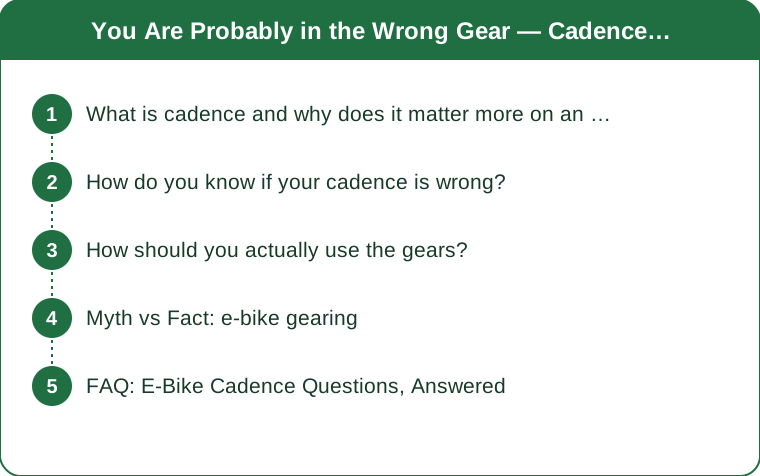
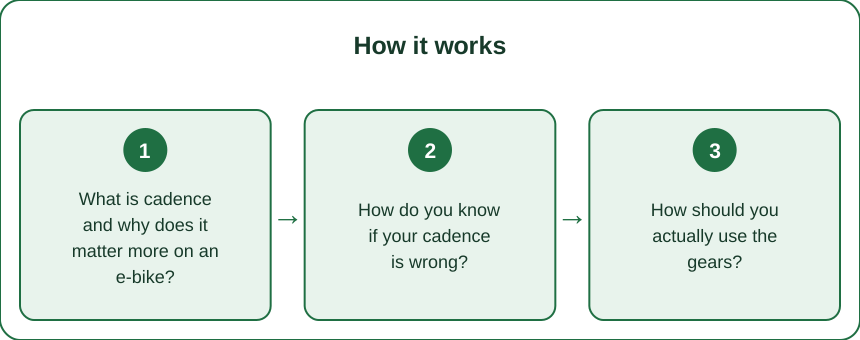
What is cadence and why does it matter more on an e-bike?
Cadence is how many times per minute you turn the pedals. Most efficient cyclists sit somewhere between 70 and 95 rpm, and recreational riders on regular bikes often drift down to 60 or below.
On an e-bike, two things change the calculation.
Mid-drive motors have an efficiency curve. They deliver power through the same drivetrain as your legs, and they are designed around a target cadence range — typically 70 to 90 rpm for most systems. Below that, the motor works at higher torque and lower efficiency, drawing more current for the same output. That is a direct battery cost, and it can be substantial: riding consistently at low cadence in high gears can reduce range by 10 to 20 percent compared to the same route at appropriate cadence.
Hub motors care less, because they drive the wheel directly and are unaffected by your gear choice. Your legs still care, and so does the wear on your drivetrain, but the battery consequence is smaller.
The joint load matters regardless of motor type. Pushing a high gear at low cadence means high force per pedal stroke, and force per stroke is what loads the knee. The same power output at 85 rpm distributes that force across nearly twice as many strokes at roughly half the peak load. For anyone with knee sensitivity, this single change matters more than any other adjustment on the bike.
How do you know if your cadence is wrong?
Three checks, none of which require a cadence sensor.
The counting test. Count your right knee rising for 15 seconds and multiply by four. Under 60 means you are grinding. 70 to 90 is the target. Over 100 means you are spinning out and should shift up.
The stand-up test. If you need to stand on the pedals to get up a hill on an e-bike, you are in too high a gear. The motor is designed to let you sit and spin. Standing on an e-bike is almost always a gearing error rather than a fitness limitation.
The knee test. Aching at the front of the knee after rides is the classic signal of low cadence and high force. It appears within a few weeks of a new bike or a new commute and is one of the most common e-bike complaints.
The battery test, for mid-drive riders. If your range is noticeably below what the manufacturer claims and below what other riders report on similar terrain, gear choice is a plausible cause worth ruling out before you conclude the battery is degrading.
Many e-bikes display cadence on the console if you look for it — it is often available on a secondary screen that people never scroll to. Worth checking, because the number is usually lower than riders guess by a wide margin.

How should you actually use the gears?
The principle that fixes most of it: change gear for cadence, change assist for effort.
These are two independent controls and most riders use only one. The common pattern is to leave the bike in one gear and manage everything with the assist level, which is exactly backwards — assist level sets how much of the work the motor does, and gear sets how fast your legs turn.
On the flat: find a gear where you can maintain around 80 rpm comfortably at your cruising speed. Adjust assist for how much effort you want to put in.
Approaching a hill: shift down before the gradient, not during it. Shifting under load on a mid-drive is hard on the chain and the cassette, and mid-drive motors put considerable torque through the drivetrain. Anticipating the shift is the single biggest thing you can do for drivetrain life.
On the hill: keep spinning at 70 to 85 rpm and raise the assist level if you need more help. Do not let the cadence collapse — that is the moment when both the battery draw and the knee load spike.
Setting off from a stop: always start in a low gear. Starting in a high gear puts maximum torque through the chain at zero speed and is where most e-bike chain wear happens.
A practical habit worth building: shift down as you slow to a stop, so you are always in the right gear when you set off. It takes a week to become automatic and it noticeably extends drivetrain life.
Myth vs Fact: e-bike gearing
Myth: The motor means gears do not matter. Fact: On a mid-drive, gears matter more than on a regular bike, because the motor’s efficiency and the drivetrain’s lifespan both depend on gear choice. On a hub motor they matter less for the battery and just as much for your knees.
Myth: Higher assist compensates for a bad gear choice. Fact: It compensates for the effort and not for the efficiency. You will still use more battery, wear the chain faster and load the knee more. Assist and gearing solve different problems.
Myth: You should use the highest gear you can manage, for speed. Fact: Speed on an e-bike is limited by the assist cutoff — commonly 25 km/h (15.5 mph) in Europe and 20 or 28 mph depending on class in the US — not by your gear. Grinding a high gear does not make you faster, it just makes the same speed harder on your body.
Myth: A cadence sensor bike behaves the same as a torque sensor bike. Fact: Cadence-sensor e-bikes deliver assist based on whether you are pedalling at all, so gear choice affects your legs but not the motor’s behaviour. Torque-sensor bikes respond to how hard you push, which makes gear selection much more noticeable.
Myth: Chain wear on an e-bike is the same as a regular bike. Fact: E-bike drivetrains wear substantially faster because of the added motor torque. Chains commonly need replacing at 1,500 to 2,500km rather than 3,000 to 5,000. Good gear habits meaningfully extend that.
FAQ: E-Bike Cadence Questions, Answered
Does this apply to hub-motor e-bikes?
Partly. The battery efficiency argument mostly does not, because the hub motor is independent of your gearing. The knee load and drivetrain wear arguments apply fully.
What cadence is best for range specifically?
For most mid-drive systems, somewhere around 75 to 85 rpm is the sweet spot for motor efficiency. Very high cadence above 100 becomes inefficient again, and is uncomfortable for most riders anyway.
Will pedalling faster make me less fit?
No — the opposite tends to be true. Higher cadence shifts more of the work onto the cardiovascular system and less onto pure leg strength, which is generally what recreational riders benefit from. If you specifically want strength, low cadence hill work is a legitimate training method, just not a good default.
My knees hurt on my e-bike. Is cadence the likely cause?
It is the most common cause along with saddle height. Front-of-knee pain points to low cadence and high force, or a saddle that is too low. Back-of-knee pain points to a saddle that is too high. Address saddle height first, then cadence.
How do I get used to a higher cadence?
It feels inefficient and slightly frantic for the first two or three rides and then feels normal. Pick one gear lower than you would instinctively choose and keep it there for a full ride. Most people adapt within a week.
Does cold weather change any of this?
Battery range drops in cold weather regardless of technique, so good gear habits matter more as autumn arrives — a 10 to 20 percent range loss below 10°C is normal, and efficient riding partly offsets it.
This is general information, not medical advice. Persistent knee pain should be assessed rather than trained through.
TL;DR:
- Target 70 to 90 rpm — most e-bike riders sit well below it because the motor hides the feedback.
- Change gear for cadence, change assist for effort. They are separate controls.
- Shift down before hills and before stopping; e-bike drivetrains wear fast under torque.
- Low cadence costs range on mid-drive bikes and loads the knee on every bike.
Gearing is the one part of e-bike riding that got quietly harder rather than easier when the motor arrived, because the motor removed the feedback that used to teach it. Count your cadence once on your next ride — most people are surprised.
Keep Reading
This article is for general informational and styling purposes only. Fit, sizing, and product availability may vary.