Does Riding an E-Bike on High Assist Actually Cancel Out the Workout?
Quick Answer: Even on high assist, e-bike riders still produce measurable cardiovascular effort and calorie burn — research consistently shows e-bike commuting and riding raises heart rate into a real moderate-intensity zone, just at a lower level than the same route on a traditional bike, not effort-free.
The assumption that a motor doing “most of the work” means the workout doesn’t count doesn’t match what heart rate and calorie studies on e-bike riders actually find.

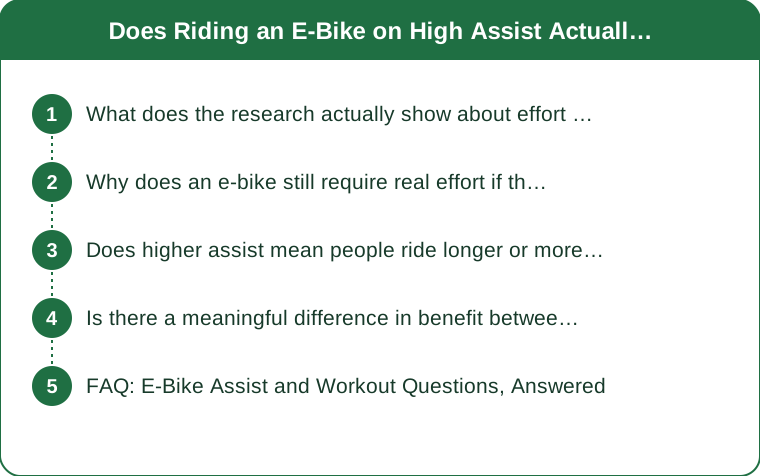
What does the research actually show about effort level on high assist?
Multiple studies comparing e-bike and traditional cycling have found that e-bike riders, even at higher assist settings, sustain heart rates that fall into a real moderate-intensity exercise zone, generally in a similar range associated with legitimate cardiovascular benefit — lower than unassisted cycling on the same route, but well above a passive, no-effort baseline.
Why does an e-bike still require real effort if the motor is doing most of the propulsion?
Pedal-assist e-bikes (the most common type) require continuous pedaling to activate the motor — the assist multiplies your pedaling effort rather than replacing it entirely, so even at the highest assist setting, the rider is still contributing real muscular work, just proportionally less than at a lower assist level.

Does higher assist mean people ride longer or more often, offsetting any reduced per-mile effort?
Research on e-bike adoption has found that easier effort per ride is associated with longer average ride duration and more frequent riding compared to traditional bikes for the same rider — meaning total weekly exercise volume can end up comparable or even higher, since the barrier to getting on the bike at all is lower.
Is there a meaningful difference in benefit between using assist on hills versus flat terrain?
Using higher assist specifically on hills (where unassisted effort would otherwise be very high or simply not attempted) while riding at lower or no assist on flatter sections is a common and effective strategy that preserves overall workout benefit while removing the specific barrier (steep hills) that stops many people from riding at all.
FAQ: E-Bike Assist and Workout Questions, Answered
Is a traditional bike always a better workout than an e-bike at any assist level?
Per mile, yes, generally — but “better per mile” doesn’t mean e-bikes provide no benefit, and total benefit depends heavily on whether the easier bike gets ridden more consistently than a harder one that sits in the garage.
Does assist level affect calorie burn in a meaningful, measurable way?
Yes — calorie burn scales down as assist level increases for a given route, but doesn’t drop to zero at any assist setting on a pedal-assist e-bike, since pedaling is still required to activate the motor.
Should someone trying to lose weight or build fitness avoid e-bikes in favor of traditional cycling?
Not necessarily — for anyone who would otherwise not cycle at all due to hills, distance, or fitness barriers, an e-bike that gets ridden consistently often produces more real-world benefit than a traditional bike that goes unused.
TL;DR:
- Even high assist e-bike riding sustains a real moderate-intensity heart rate, not a passive one
- Pedal-assist motors multiply pedaling effort rather than replacing it
- Easier effort is linked to longer, more frequent rides, which can offset lower per-mile burn
- Using higher assist strategically on hills preserves benefit while removing a real barrier to riding
High assist makes it easier, not effortless — and easier that actually gets ridden often beats harder that doesn’t.
Keep Reading
This article is for general informational and styling purposes only. Fit, sizing, and product availability may vary.